

Creating Smaller Trees for Small Gardens
How I use Different Techniques for Controlling Tree Height & Spread


Hello, friends! This next month is incredibly busy as I am sure it is for many of you. We have end of school activities which are more than usual this year as my kid is leaving middle school. Plus all of the regular work and gardening everything. It’s just BUSY!
But that being said, it’s a great time out in the garden, and I’m here to answer questions as they arise! So if you have questions, drop a comment, and I will do my best to answer for you!
In Today’s Post:
My great Copper Beech Ball experiment: I saw them at the Chelsea Flower Show last year, and now I need some!
How to Keep Trees Smaller — and why you might want to do so!
A peek into my Orchard which, I realized this week, I have never shown here on Substack!
We all hope you will stick around!
Join our jolly community of Resistance Gardeners, and let’s get stuck into the dirt together!
And in case you are one of the MANY who are considering ditching their lawns for alternatives this year, here is a collection of posts which may be helpful:


Ok. Let’s get started!

A few weeks ago I started an experiment. When I was at the Chelsea Flower Show last May one plant in particular stole the show for me: the Copper Beech Balls in Jo Thompson ‘s show garden, The Glasshouse Garden. They are a really beautiful and unusual form of topiary — frankly, they are almost more of a really big bonsai tree. And I had never seen anything like it.
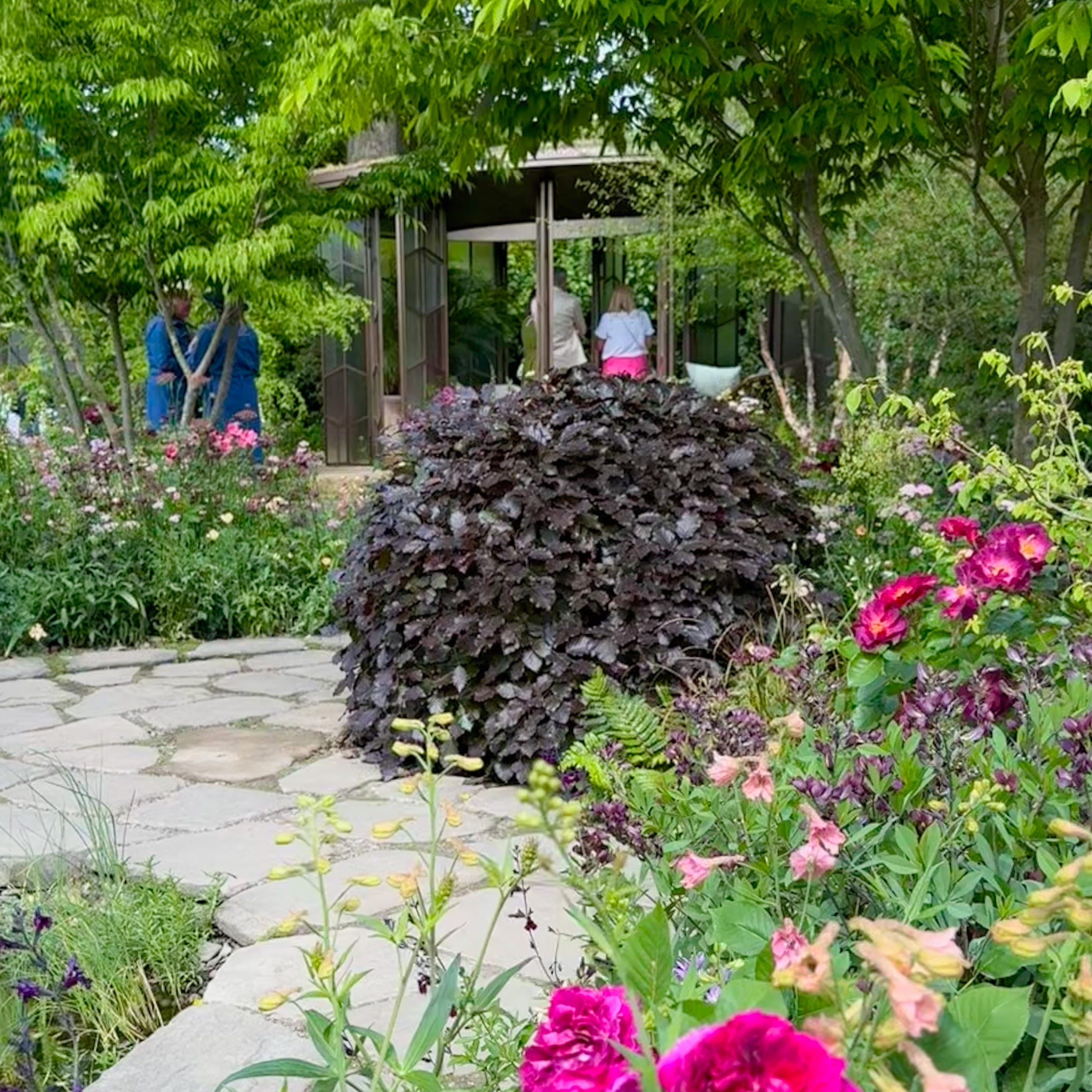
I came home from London and immediately did some research about these Beech Balls. I wanted to know: was anyone selling them in North America? The answer, unfortunately, is no. And there are a couple of reasons for that, I assume.
First, according to Jo Thompson, who has seen them without their leaves, these trees are probably 10 years old. That is a long time spent developing a living product. That means that those trees when they are sold as Beech Balls are incredibly expensive, too. It takes a lot of resources to get a tree trained over the course of 10 years or more.
So if anyone is thinking about bringing them to market, we won’t see them for years or even a decade.
But the second factor is even more discouraging: Beech leaf disease. Beech leaf disease is spreading across North America from the East Coast westward. And it is a threat to all beech trees on the continent. It’s spread by a nematode, and because the nematode is microscopic, detection only happens when the disease has manifested. And at this point there is no prevention, no treatment, and no cure.
Therefore, the prospects of Copper Beech Balls being available or even viable in North America, is very small. You don’t invest heavily in growing a 10+ year product that may succumb to an untreatable disease. So I doubt growers are even considering this as a product.
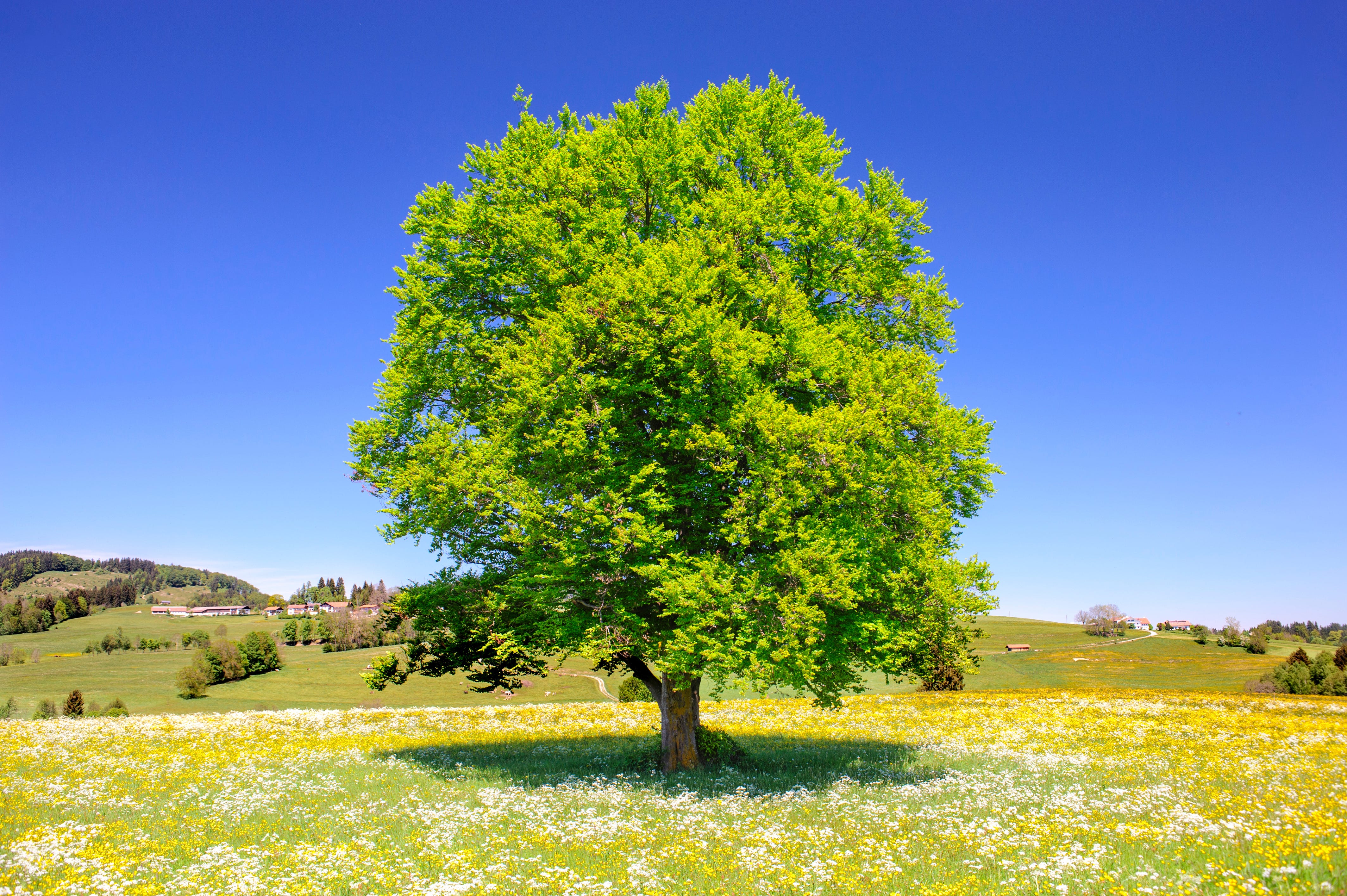
However, beech trees aren’t the only trees that can be trained this way. At least I don’t think they are. Beech trees are a great candidate because when they grow to be full-size, they almost look like lollipops. Their canopy has a very rounded shape naturally. So even when they are miniaturized, as they are to make these Beech Balls, they still take on this multi-branch rounded shape, which is then enhanced by strategic pruning.
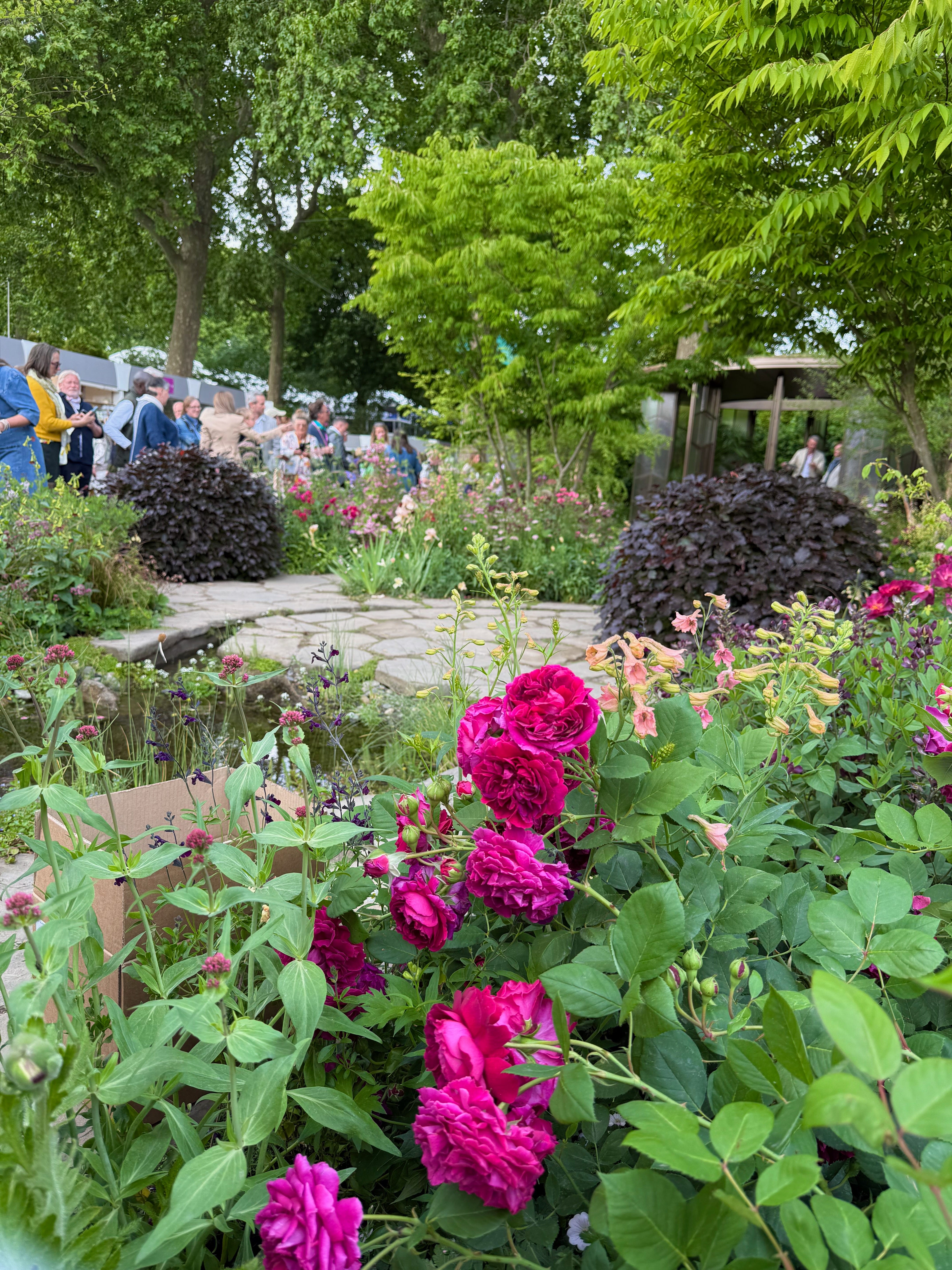
Now I’ve never seen one of these Beech Balls without its leaves. That would tell me so much! And maybe when I get to the UK next time I will be able to go to the nursery where they grow these trees and find out a little bit more. Jo Thompson did report that their trunks are enormous and estimated that they are at least 10 years old.
But I have done some sleuthing and based on what I know about Backyard Orchard Culture and tree pruning in general, this is what I guess is happening:
I suspect they start with one year-old whips, cutting them at say 18 to 24 inches tall. Then they train the branches into this rounded form over years. Given that beech trees naturally branch in a rounded form anyway, this is just an adaptation of their natural growth pattern. They are essentially creating shrubs out of trees. Miniaturizing them. And then maintaining that size by pruning. It’s a long game. I’m guessing 10 to 15 years. But the result is gorgeous!
So given that beech is a bad choice for North America right now, I did some research to see what tree could be a good substitute. I wanted to go with something that is:
native to North America
naturally rounded in form
more of an under-story tree that will grow in part shade.
naturally on the smaller side.
It also had to be something that would survive in Colorado in Zone 5|6.
I came up with one reasonable option that met all of that criteria: the Eastern Redbud Tree | Cercis canadensis.
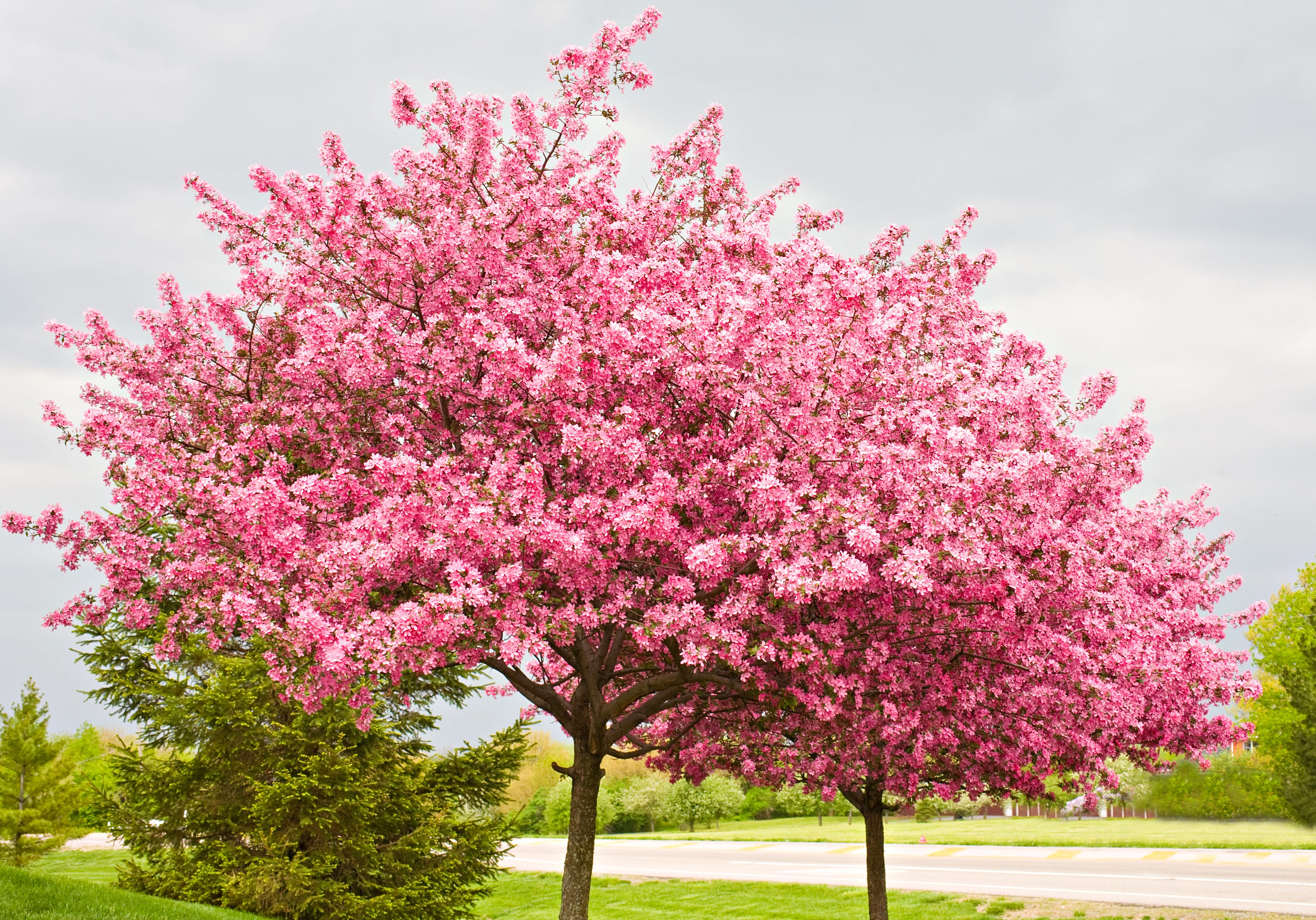
Eastern Redbud trees are not native to Colorado, but they are native to the eastern part of the United States and Canada. They do have more of a rounded form naturally. And they seem to branch in a similar way to beech trees. They are a smaller understory tree. And they bloom! So unlike the beech trees, if this works, they will have four distinct looks: spring bloom, summer green, fall color, and bare branches in the winter.
I ordered three 1 year-old whips. A whip is just a young tree, and they are sold bare root. That means they’ve been grown in the ground, dug up, and the root ball is exposed. They arrived in the mail, and I decided to plant them in a part-shade part of my cutting garden. I have three raised beds there, so I put one in each of the raised beds.
If I had a bigger garden, I would have some kind of a working nursery area where I could experiment and no one would ever see it. But I don’t. So I wanted to choose an area where these little trees would just blend in to everything else that’s growing there for a while. And honestly, right now you don’t even see them!
I planted the whips in the ground, and then I cut them off at about 24 inches tall. I cut them all at the same height. And I cut right above a node – at a 45° angle. The angle ensures that any moisture that falls on the cut will runoff rather than causing rot. And cutting above a node means that growth hormones will force branching at and below that node.
So how do I know this works?
Well, a few years ago when I started my Orchard, I did the same thing to 18 fruit trees. It was absolutely nerve-wracking. But it worked! Of course it takes a while for new branches to emerge, but I have spent the last few years training and sculpting my Orchard trees into really cool, beautiful, and very small fruit trees. Last year, I even got two apples!
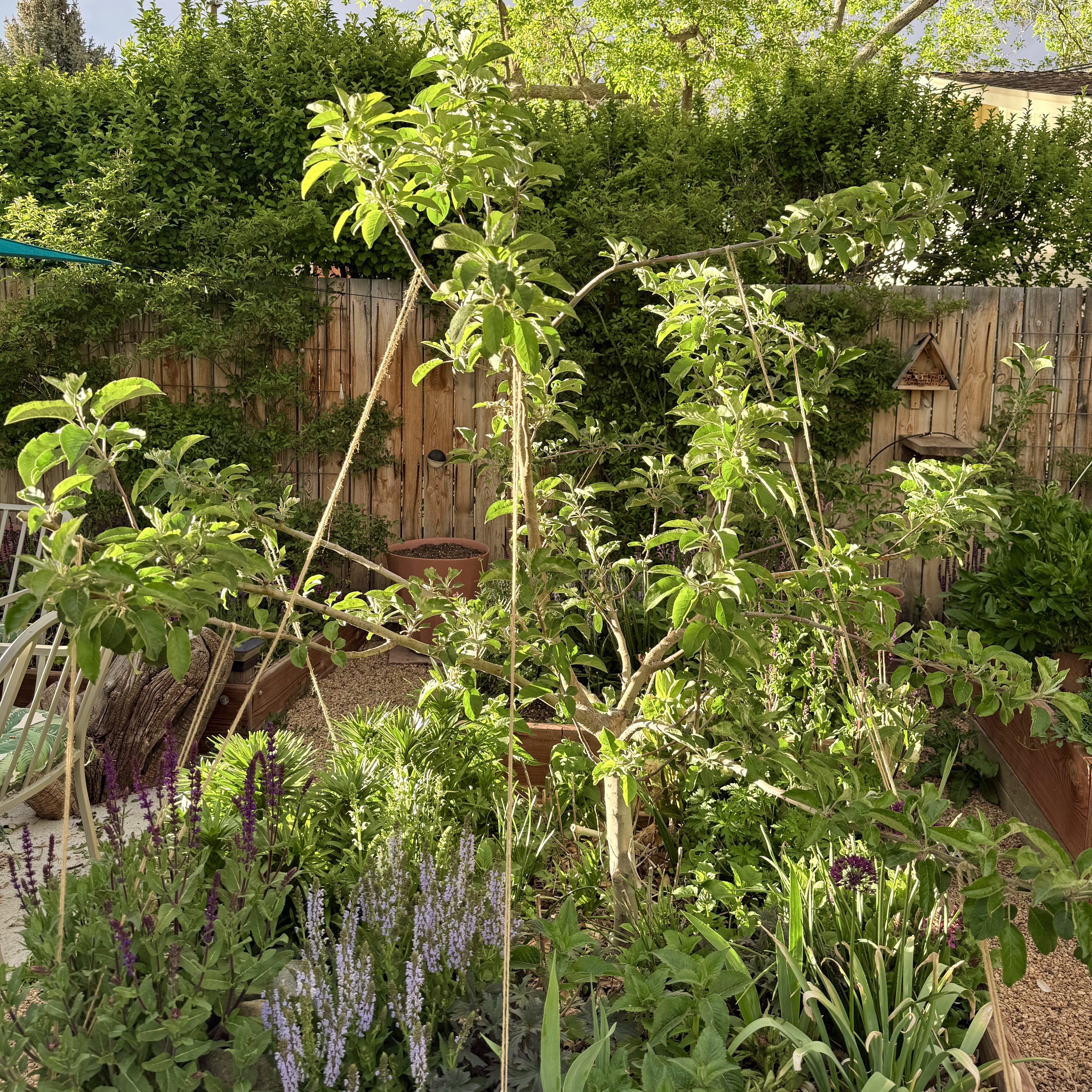
The thinking behind this is not new. Human beings have been pruning and training trees in a variety of ways for millennia. We have the technique of espalier trees, for example, where trees are trained in rather elaborate shapes against a wall or fence.
These techniques are not only beautiful, but they are incredibly practical. It’s very difficult to pick all of the fruit off of a 25 foot tall apple tree. But you can very easily pick all the fruit off of a 6 foot apple tree. And you can fit more 6 foot apple trees in a smaller space which means you can have more varieties. They won’t all ripen at the same time. And smaller fruit trees require less water. So by training our fruit trees – or any trees to be smaller – we can have more trees.
When we bought our house here in Colorado, there were four trees on the property: a very large cottonwood, a very large and very sick maple tree, a medium-sized sandcherry, and an ash tree that had been pruned so poorly that it threatened to split in half. Within the first three years that we lived here, we had the maple tree taken down to just the trunk. And we took down the ash tree completely. So we were left with two trees.


I know how important trees are to our ecosystems. They are hosts for larval caterpillars, for example, and nesting places for birds. They provide shade. And they provide color and structure within a garden. So I was committed to planting more trees.
But part of the reason our maple tree died is because maple trees are not native to Colorado, and they need a lot of water. Planted in 1958, it was an enormous maple tree which required an enormous amount of water and had been starved of water for decades.
So I wanted to plant lots of new trees, and I have chosen many which are native to our area and will be better suited.
But I also set about learning how to keep some of my trees smaller. Some people keep the trees smaller because they have a small space. I am trying to keep my trees smaller so that they require less water.
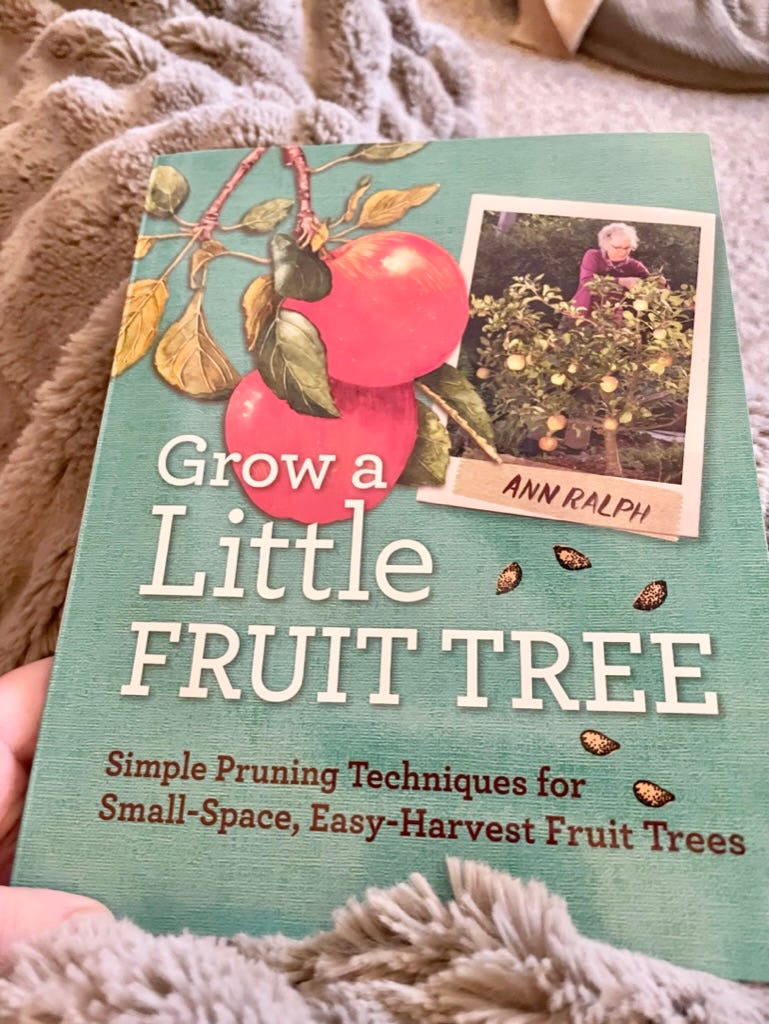
So for my Orchard trees, I am using the Backyard Orchard Culture techniques which involves rather severe initial pruning and twice-yearly maintenance to keep them small and manicured.
So far it’s working!
But I have other trees that I am keeping smaller in other ways as well. In general, there are several ways to restrict the size of a tree:
Containers: restrict the size of its root ball – namely, keep it in a container
Competition: plant multiple trees close together
Pruning: regularly or selectively
Root Stock: choose trees with what’s called “dwarfing root stock”
Coppicing: cutting down the entire tree or selected stems (depending on the variety) at regular intervals
In the Wildlife Garden, I have planted two groupings with three trees, each: two Amelanchiers and one Chokecherry in each group. These trees are all planted very close together. That competition for resources will automatically keep those trees a little bit smaller.
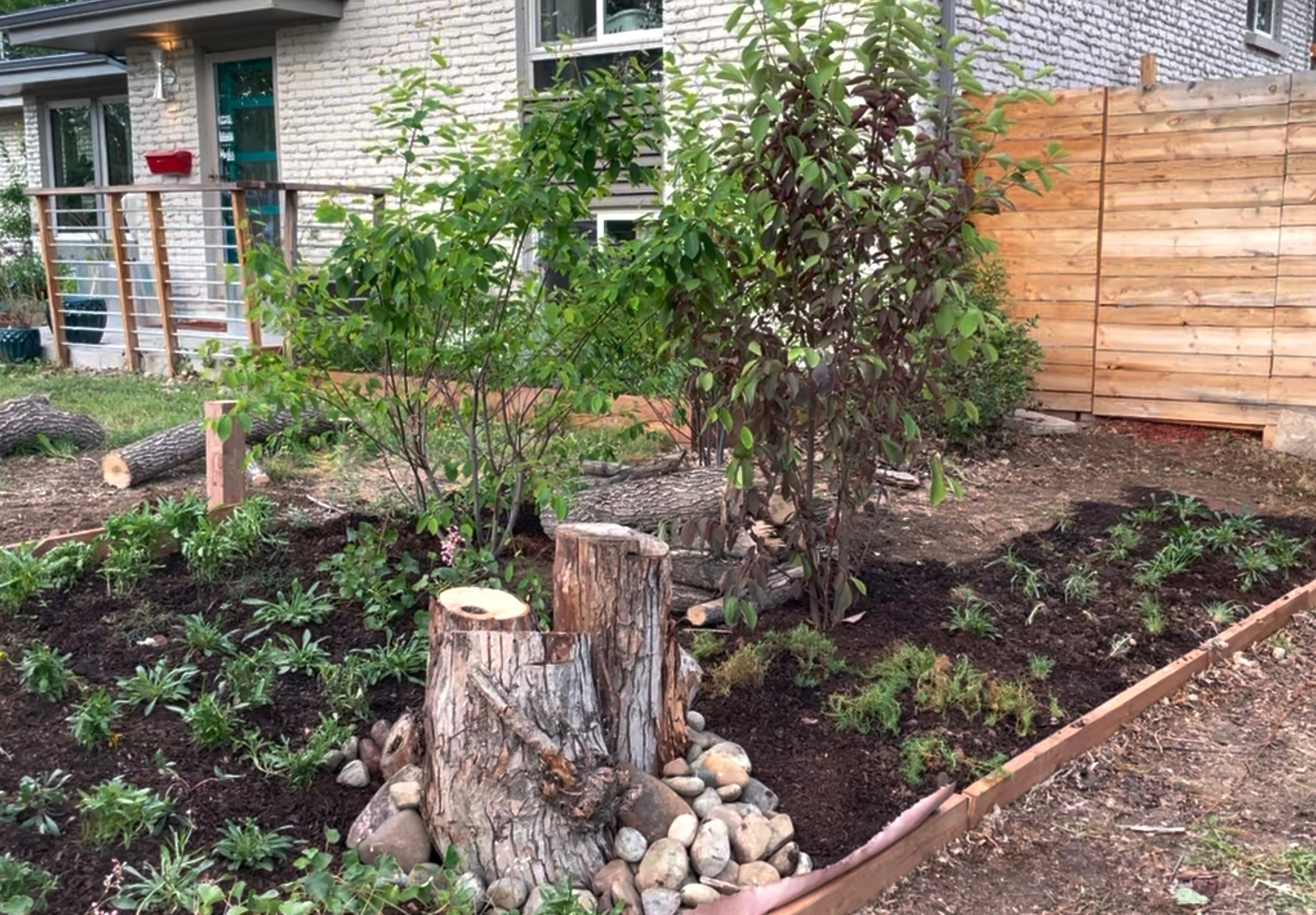
But I also am employing another technique called coppicing or stooling. Coppicing has been used to regenerate trees for more than 10,000 years as a way to manage woodlands and provide firewood and wood for construction. Essentially: multi-stemmed trees are cut back by a third every few years. The wood that has gained is then used in a variety of ways, but this continual renewal of the tree can help keep trees healthier because essentially everything that is above ground is relatively young all the time.
So my Amelanchiers, for example, will be cut back by a third every few years. They are multi stemmed. And that new growth will help to keep them shorter, and also healthier. The Chokecherry will be treated in the same way when it gets too big to be pruned at the top I will simply cut the tree down and new growth will emerge. That is a cycle that is a bit longer, but it’ll be an interesting experiment!
All of this is to say: you don’t have to just allow trees to become enormous. There are techniques to keep them in different shapes and sizes to suit your landscape. This is easier with some varieties done with others. Pruning evergreens, for example, is kind of tricky. But many deciduous trees are relatively easy to manage.
And honestly, a lot of it is just an experiment – trial and error, with lots of errors! But it’s also kind of fun, and I used to think pruning must be so much work, but it really isn’t. It’s two or three days per year of work, and the rest is enjoying the results – and watching the experiment unfold.
So I guess this is my encouragement to you: try something new!
Now I will say this: I would not go out and spend several hundred dollars on a mature tree and then use it for an experiment. First of all that tree is old enough that that probably would not be successful. But also there is an inherent risk of failure in an experiment. So buy a whip instead – a little bare root tree that doesn’t cost all that much. Then, if the experiment doesn’t work, you have not invested as much into the end product.
But here’s my hope: maybe in a few years, I will come back to you and say, “Look! Look at my amazing Redbud Ball! Here’s how you can grow one, too!”
That would be pretty cool! Stick around, and we will watch what happens together.

The Snow! I’m still assessing the damage. Fortunately, I don’t think it is too bad, but I have some young trees I’ll be watching pretty carefully for signs of root rock.
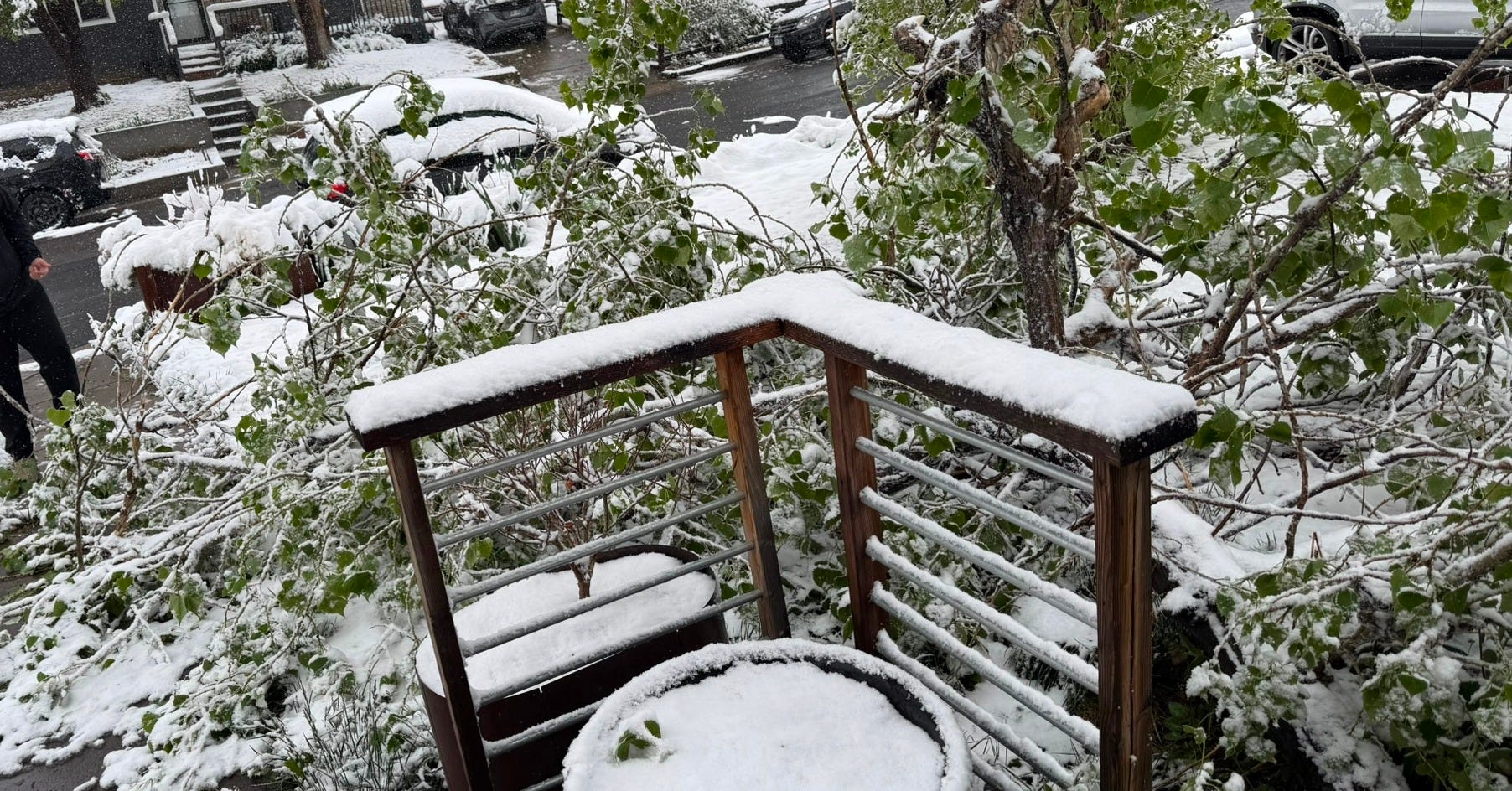
This week in my garden | Colorado Zone 5|6:
What I’m Planting: Vines. Lots of vines! I have a back fence that needs some blooms on it, so I have two going in this week: 'Major Wheeler' Honeysuckle | Lonicera sempervirens 'Major Wheeler' and Clematis texensis ‘Gravetye Beauty.’ Both are hybrids of native North American climbers, and my hope is that back fence will become a hummingbird haven in a few years.
What’s Blooming: I am still assessing the storm damage. The biggest worry with a storm like this is the low temperatures. If it stays above 28-ish, I don’t worry much. But when it gets down into the low to mid 20s, blooms will freeze. I will take time, however, to assess. If within a week those flowers really look dead, I’ll cut them back. Still at the evaluation stage, though.
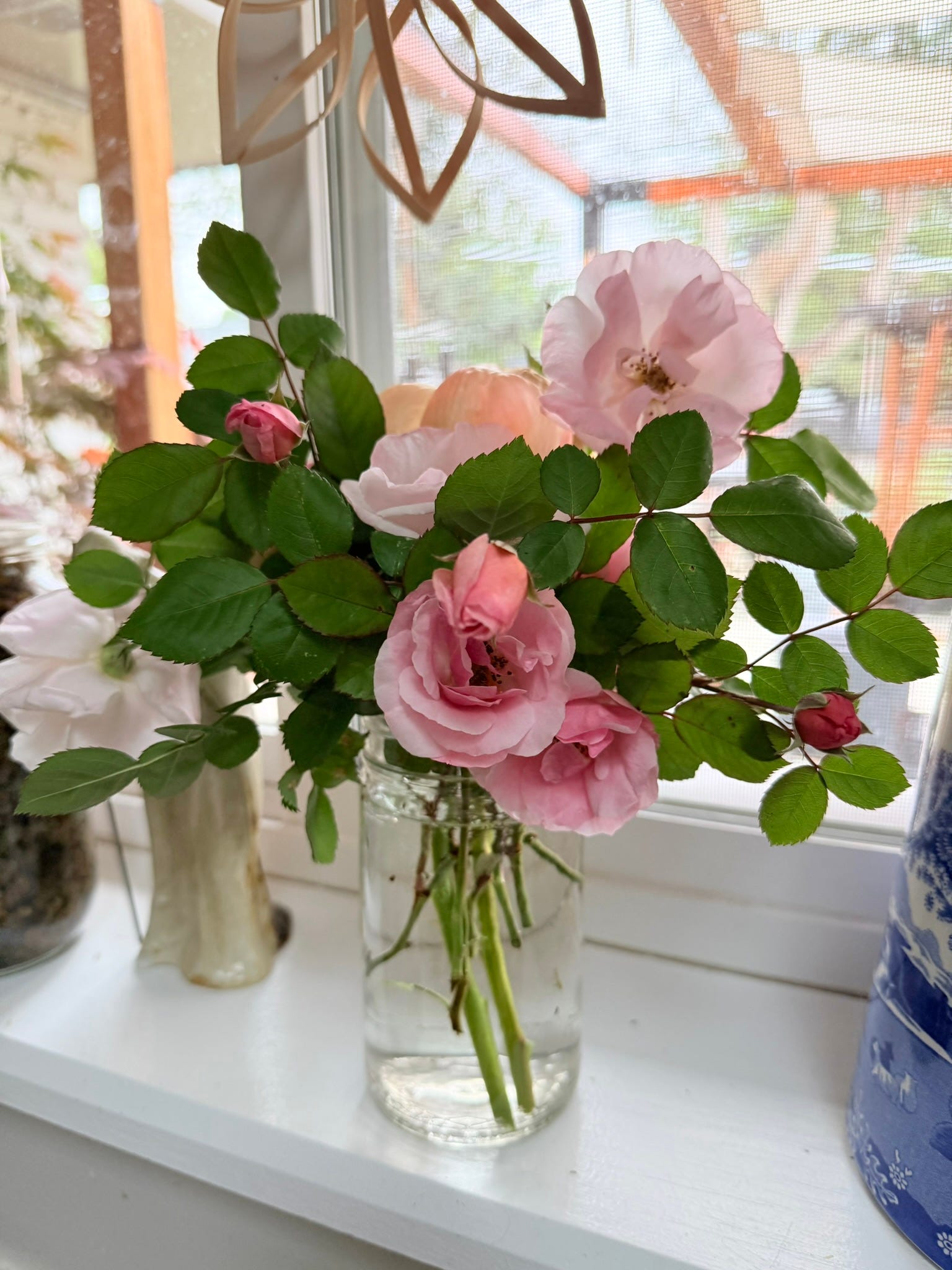
Mother’s Day: Today is Mother’s Day. I know this is a day that can be hard for many people, and I want you to know that I see you.
For those who grieve for your mothers…
For those who grieve broken maternal relationships…For those who have been forced to cleve from your mothers…
For those who long to be mothers…
For those who will never be mothers…
For those who miss your mothers…
We see you.
You are beloved.
For those who struggle as mothers…
For those who share in mothering as stepmothers and foster parents…
For those who mother without enough time or money or paid leave or emotional bandwidth or community support or patience…
For those who mother alone physically or emotionally…
For those who mother in ways you never recieved mothering…
For those who mother children in your classrooms, your studios, as mentors and neighbors and friends…For those who mother knowing that a Pinterest board or a TikTok isn’t reality, but sometimes it’s enough to make you feel shamed anyway…
For those who mother because mothering is a verb which means loving and nurturing children in beautiful, healthy ways — all children…
We see you.
You are beloved.
Here’s to a fabulous week for you all!
Here’s an easy way to support Wild Revival Gardening: if you enjoyed this post then click the heart 🩷, give it a restack 🔄, and drop a comment 💬 . Doing so makes a big difference for writers like me, and your clicks help to put this newsletter in front of more gardeners like you! Mwah!
Happy Gardening!
Angela

I hope your freeze damage is minimal. We had unseasonable heat here early on the east coast followed by an unusual deep freeze in April. The double weather whammy has local orchards from NJ to VA reporting that cherries are a total loss and apples and peaches are expected to be a 50 to 80% loss. Going to be a sad summer and fall here. Hoping our local fruit farmers can survive.
This is so fun! Can't wait to see the results.